
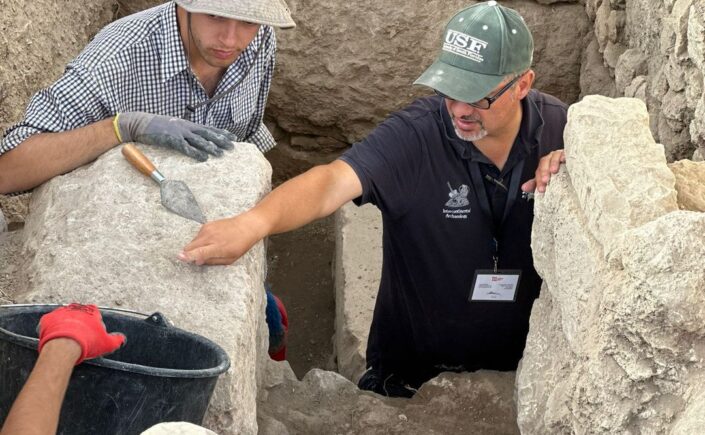
Shohet Scholars 2026–2027
Madeleine Kraft
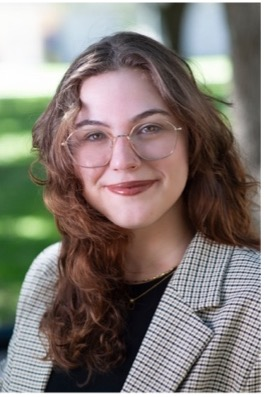
Project: “Digitization and Datafication of the Roman Catacombs of the Mediterranean: The Catacombs of St. Agatha, Rabat, Malta”
Project Description: This project aims to utilize 3D Terrestrial Laser Scanning (TLS) to capture the complex in a high-resolution, meteorologically accurate 3D point cloud model for public and scholarly use. The project also includes the datafication of 3D data to be integrated into an in-progress database project, Corpus Catacumbarum Mediterranearum.
Bio: Madeleine Kraft recently received her PhD in Public History and Digital Humanities from the University of South Florida, where her dissertation focused on addressing legacy data on the catacombs of Sicily and Malta, reassessing the ways in which these spaces hosted religious interactions and how these interactions manifest themselves in material culture. A major component of her research project was the production of a database, incorporating legacy data, recent excavation data, and remote sensing data to allow for a more thorough analysis of the religious communities that utilized these cemeteries and the shifting narratives of such through several centuries of intrigue regarding these spaces. The Shohet Scholar’s Grant will enable her to further this research with a remote sensing project focusing on the Catacombs of St. Agatha (Rabat, Malta), where the major issues she wishes to tackle include the accessibility of the site and the knowledge it contains, for both the general public and for scholarly communities, via the creation of a 3D digital twin of the site and a more thorough and reliable map.”
Grace Funsten
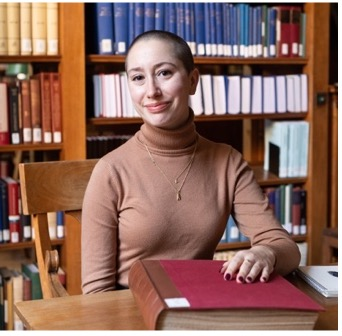
Project: “Hidden Verses: The Poetics of Roman Columbarium Inscriptions”
Project Description: This is a book project with research in Rome that examines verse epitaphs that can be securely attributed to specific columbaria, collective burial monuments that primarily served enslaved and freed people in Rome.
Bio: Grace Funsten is a Teaching Assistant Professor in the Department of Classics at the University of Pittsburgh. Her research interests include Roman poetry, epigraphy, slavery, gender, and sexuality. She has published on literary allusions in an ancient verse epitaph for a dog named Margarita, appearances of magical practice in Ovid Heroides 21, and impotence scenes in Ovid and Maximianus. Her current book project explores the literary practices of subaltern people in the early Roman Empire by examining verse inscriptions found in collective subterranean burial monuments known as columbaria. The Shohet grant will support her project examining verse epitaphs that can be securely attributed to specific columbaria, collective burial monuments that primarily served enslaved and freed people in Rome.
Christy Cobb
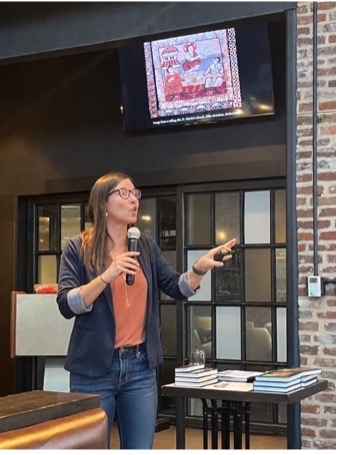
Project: “Early Christian Families”
Project description: This is a book project with research in Rome that will focus first on researching Augustan legislation and then epigraphic collections.
Bio: Christy Cobb is associate professor of Religious Studies at University of Denver. Cobb is the author of Slavery, Gender, Truth, and Power in Luke-Acts and Other Ancient Narratives (2019). She is also the co-editor of Ancient Slavery in Its New Testament Contexts (2025) and a volume entitled Sex, Violence, and Early Christian Texts (2022). A member of the editorial board for the Journal of Feminist Studies in Religion, Cobb’s research and teaching interests include slavery, gender, sexuality, early Christian families, Acts, and the Apocryphal Acts. Cobb’s forthcoming book, Enslaved Women in Early Christianity: Invisible Labor, will be published in the “Sexing Scripture” series by Bloomsbury in 2027.
Kelly McClinton
Project: “ArchAI: Archives and AI in ‘Roma Sotteranea”
Project description: This project utilizes AI to aid the digitization and organization of legacy data on catacomb scholarship at various archives in Rome and elsewhere.
Bio: Kelly McClinton is currently finishing a DPhil at the University of Oxford with a focus on Early Christian Art & Archaeology. This summer, she will begin a postdoctoral project entitled ‘ArchAI’ hosted between the University of Chicago, the University of Cambridge, and the Biblioteca Hertziana in Rome.
Bernard Frischer
Project: “Ritual Awe and Sacred Time in the Classical and Christian Pantheon”
(VR Project: “From Mars to Mary”)
Project description: This project is developing a Virtual Reality tour, which will be free and available to the public, to showcase the findings of Frischer’s recent study, “From Mars to Mary: The Pantheon’s Transformation from the Temple of Mars Invictus to the Cult of S. Maria ad Martyres,” forthcoming with Cambridge University Press. The study presents empirical archaeoastronomical evidence that the Pantheon’s design—specifically the oculus diameter and orientation—was engineered to create dramatic solar and stellar alignments on dates associated with Mars, Romulus (Quirinus), his wife Hersilia (Hora Quirini), and Julius Caesar. Furthermore, it demonstrates that the Christian rededication of the temple in 609/613 CE constituted a deliberate act of temporal, spatial, and theological supersession, utilizing the same solar effects to sanctify the new cult of the Virgin Mary and the Martyrs.
While the forthcoming Cambridge University Press publication documents these findings via text and 2D images, static media cannot adequately convey the dynamic, temporal nature of these hierophanies. The proposed VR tour, produced by Flyover Zone (founded by Bernard Frischer), hosted on the Yorescape platform, and distributed at no cost, will allow scholars, students, and the general public to re-experience these phenomena from the perspective of the ancient worshipper. Users will stand at the digital reconstruction of the external altar and witness the solar beam framing the entrance, then move into the rotunda to see the light illuminate the agalmata of Mars, Venus, and Julius Caesar. This immersive experience will be integrated with the digital publication (expected to appear in late 2026 or early 2027), establishing a new model for scholarly communication that combines humanistic research with accessible, experiential learning.
Bio: Bernie Frischer is a digital archaeologist and author of six books and numerous articles on virtual heritage, Classics, and the survival of the Classical world. He received his B.A. summa cum laude in Classics from Wesleyan University (CT) in 1971 and his Ph.D. in Classics summa cum laude from the University of Heidelberg in 1975. From 1974 to 1976, he had a two-year Prix de Rome fellowship at the American Academy in Rome. After leaving Rome in 1976, he taught Art History, Classics, and Informatics for 47 years at UCLA, the University of Virginia, and Indiana University. He retired in 2023 and is now a professor emeritus at those institutions.
From 1996 to 2003, he directed the excavations of Horace’s Villa (Licenza, Italy) sponsored by the American Academy in Rome. In 1996 he founded the UCLA Cultural Virtual Reality Laboratory. The lab was one of the first in the world to use 3D computer modeling to reconstruct cultural heritage sites. He left UCLA in 2004 to direct a digital humanities center at the University of Virginia, where he started the Virtual World Heritage Laboratory. He later moved the lab to Indiana University.
In 2022, Frischer founded Flyover Zone, Inc., an ed-tech company based in Bloomington, Indiana. The company’s mission is to commercialize products and services using 3D digital technologies to present cultural heritage sites and monuments to students and the general public.
Shohet Scholars 2025-2026
BOSTON, MA – May 15 th 2025 – The International Catacomb Society (ICS) is pleased to announce the 2025 recipients of the Shohet Scholars Grant for Research on the Ancient Mediterranean. This competitive grant supports original research that advances the understanding of Jewish, Christian, and other religious communities in the ancient Mediterranean world.
This year, ICS recognizes four outstanding scholars whose projects demonstrate excellence in historical inquiry, archaeological research, and interdisciplinary approaches to the ancient world:
- Mary Jane Cuyler, Independent Researcher
“The Cult of the Bona Dea at Ostia and Portus”
The grant will support an investigation of evidence for the largely overlooked cult of the Roman goddess known as Bona Dea, including archeological remains, inscriptions, and archival records from past excavations in Ostia and Portus.
- Caroline Johnson Hodge, Professor, College of the Holy Cross
“With Offerings for the Dead’: Space, Ritual, and Power in Early Christianity”
The grant will support work cataloging burial sites in Rome related to the Christian cult of the dead.
- Chance Bonar, Postdoctoral Fellow, Tufts University
“Religiosity and Slave Revolts in the Ancient Mediterranean”
The grant will support research on how religious practices and expressions both fueled and
suppressed ancient slave revolts.
-
- Mark Ellison, Associate Professor, Brigham Young University
“The Vision and Purification of Isaiah in Christian Liturgical Art”
- Mark Ellison, Associate Professor, Brigham Young University
The grant will support on-the-ground documentation of early Christian liturgical art that depicts the Vision of Isaiah.
The ICS warmly congratulates the 2025 Shohet Scholars and looks forward to the contributions their work will make to the field.
About the International Catacomb Society
Founded in 1980, the International Catacomb Society is a non-profit organization dedicated to the documentation, study, and preservation of ancient Jewish, Christian, and other religious sites in Rome and across the Mediterranean basin.